

Conversations on Clinical Content: ISPEP's Key Takeaways from the C3 Summit
- Olivia Kersey

- 3 hours ago
- 5 min read
Olivia Kersey, ISPEP Strategic Programmes and Partnerships Director


The C3 Summit in London brought together professionals across patient engagement, clinical operations, medical affairs, and digital technology to discuss a range of topics relating to clinical trials. The programme stood out for its strong weighting towards panel discussions, enabling depth of exchange between speakers. ISPEP was well represented throughout – our Founder Emma Sutcliffe opened the day, and panellists included our Advisory Board Chair Steve Clark, collaborating partner Lisa Kerr from Evinova, and Vivienne Hanrahan from Sprout Health Solutions, our very first organisational members. This event was less specific to patient engagement than others we have attended recently – we appreciated the opportunity to champion patient focus outside of our typical ‘bubble’ – but there was plenty to take away for the ISPEP community. Here’s what stood out for us.
What good looks like: core principles for a patient-focused industry
Emma's opening keynote covered six principles for sustainable patient-centric healthcare. In particular:
Clinical trial data must be complemented by real-world evidence from patients’ perspectives in order to reflect the true impact of a therapy on people’s lives. Patient-reported outcomes, embedded as core success measures, are a key data type to capture for this.
Again thinking about ‘the real world’, access has to be “designed in” much earlier than is often the case. A therapy that can't reach the people who need it delivers no value – therefore, access should not be treated as a downstream challenge to solve after approval.
It’s also crucial that “shared value” is built by aligning incentives to patient outcomes. Progress depends on forming market-based incentives around what matters to patients, creating a common language across healthcare stakeholders and meaningfully easing the path to treatments and services that serve human as well as commercial needs.


The common thread across Emma’s presentation was that professionalising patient engagement is necessary to deliver on these principles. As such, ISPEP's closing call to action was outlined as: make patient engagement mandatory, invest in professional capability, and align on shared standards. The alternative means patient engagement is treated as a passion project rather than a professional discipline, remains unprotected and unsustainable under pressure, and falls victim to fragmentation, compromised efficiency, and ultimately, failure to deliver impact.
Clinical trials: hard to access, hard to stay on
The patient partnership session featured Jamie Tierney, whose son lives with muscular dystrophy. Jamie’s initial interactions with pharma yielded only generic responses – so he built his own pathway through conversations with other families and experts. As impressive as this is, it should never have been necessary – the pharmaceutical industry is clearly not performing well in terms of reaching patients and families who are keen – or even desperate – to take part in a clinical trial. Historical caution around inappropriate promotion must be balanced with supporting the ethical need for patients and families to be meaningfully informed of their treatment options – especially in cases where a clinical trial may be their only hope.
What’s more, once patients are enrolled, it can be incredibly challenging to stay involved with a trial. In a later panel, Emma highlighted how participating in a simulation provided by ISPEP partners ‘A Life In A Day’ alongside colleagues in her past industry role revealed how severely the physical and emotional demands of illness and research participation are underestimated.
One potential solution for delivering more patient-friendly trials was proposed by Lisa Kerr from Evinova; Lisa suggested integrating patient experience into calculations for ‘Probability of Technical and Regulatory Success’. PTRS is a metric used by pharma to guide investment decisions based on the likelihood of an investigational treatment both meeting clinical objectives and specifications and satisfying regulatory requirements. PTRS is informed by a wide range of variables; Lisa’s framing outlined how patient experiences of being on a trial can be considered as part of assessing the expected success of a trial design in terms of recruitment and retention; this can incentivise patient-friendly trial designs by directly linking patient experience with financial viability.
Patient information leaflets are changing for the better
In a session dedicated to the digitisation of patient information leaflets (PILs), Steve Clark (Strive for Five) made numerous excellent points about the need for transformation and how this can be done well. In particular, Steve noted how fear-inducing and impenetrable PILs are, calling for co-creation with patient organisations and contextualised “cautious optimism” in risk communication. Liz Clark, pharmaceutical physician, noted the potential for transferring knowledge and best practices from work done on plain language summaries to ensure accessible language and formats.
Panellists also discussed how new digital formats enable a more patient-friendly experience, for example by presenting content in a “layered” and personalised fashion that may be informed by AI tracking of how patients are engaging with the materials (e.g., which sections they dwell on for longer).

The ‘everyday value’ of AI for patient engagement professionals
A big focus of the afternoon was how professionals are using AI in their day-to-day work. For patient engagement specialists, the biggest takeaway was that the value of AI lies in handling ‘low-value’ tasks such as documentation and administration in order to free up time for meaningful human interactions, trust-building, and strategic excellence. Indeed, patient engagement – especially in industry settings – often comes hand-in-hand with contracts to process and compliance forms to fill out, particularly in highly-regulated countries like the United Kingdom. The potential of AI to – ironically – shift the balance in a more human direction, while maintaining regulatory standards, is an appealing prospect.
Audience perceptions and closing thoughts
The final panel of the day featured Emma and was opened by a series of audience polls to spark discussion. The first poll revealed that 24% of the audience considered delivering accessible, inclusive trials to be the biggest challenge in clinical development (from the options provided), echoing sentiments shared earlier in the day. Similarly, the audience voted that 'Improving trial diversity and access' should be top priority of industry over the next three years.
Another poll focused specifically on the biggest challenges blocking AI implementation in this setting, with patient privacy and data governance coming out on top. Regulatory uncertainty received the next-highest number of votes, prompting Emma to draw comparisons with the ineffective / slow adoption of social media for patient engagement by pharmaceutical companies. She emphasised that while regulatory concerns were also noted in that context, the same level of friction does not seem to be happening for AI adoption, suggesting that there may well be untapped potential for effective use of social media for patient benefit that requires a mindset shift as well as greater regulatory knowledge.
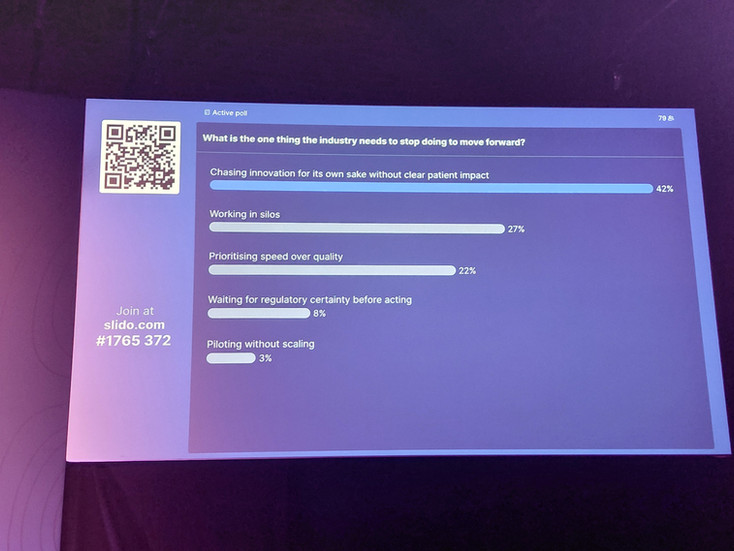
The final poll posed the question ‘What is the one thing that industry needs to stop doing to move forward?’, with the most popular choice being “Chasing innovation for its own sake without clear patient impact”. On this topic, Emma gave the example of protecting value for patients by balancing the inclusion/creation of patient-reported outcome measures with ensuring patient burden does not become excessive.


Overall, the C3 Summit was a thought-provoking event that we thoroughly enjoyed and greatly hope to attend next time. We would love to hear your thoughts on the insights shared – let us know in the comments. If you’re keen to help transform insight into action, get in touch to find out how we can move from conversation to collaboration – we’re here to help #CarryTheChange.


The ISPEP team and community showing up! From left to right: 1) Olivia Kersey (ISPEP), Kate Jackson (A Life In A Day), Emma Sutcliffe (ISPEP), 2) Steve Clark (Strive for Five), Lisa Kerr (Evinova), 3) Vivienne Hanrahan (Sprout Health Solutions), Emma Sutcliffe (ISPEP), Adelaide Anderson (Sprout Health Solutions), Rasmus Hjorth (James Lind Care), and Nick Hall (Sprout Health Solutions).
Thank you to TransPerfect for inviting Emma as Keynote Speaker and welcoming Olivia to enable the development of this community report. ISPEP conference participation and reporting is made possible by kind sponsorship from event organisers; please get in touch if you would like to learn more about how ISPEP can support your event.


Comments