

The 8th Patient Centricity & Collaboration World Congress: Day Two Highlights

Following a packed opening day with discussions covering systems-wide reform, patient experience data, meaningful co-creation and more, Day Two of the 8th Patient Centricity & Collaboration World Congress delved into topics such as:
Diversity, equity, and inclusion
The value of patient perspectives in early drug discovery.
Information and support needs for patients, families, and trial participants
Read on to learn more…
Progressing DEI in research
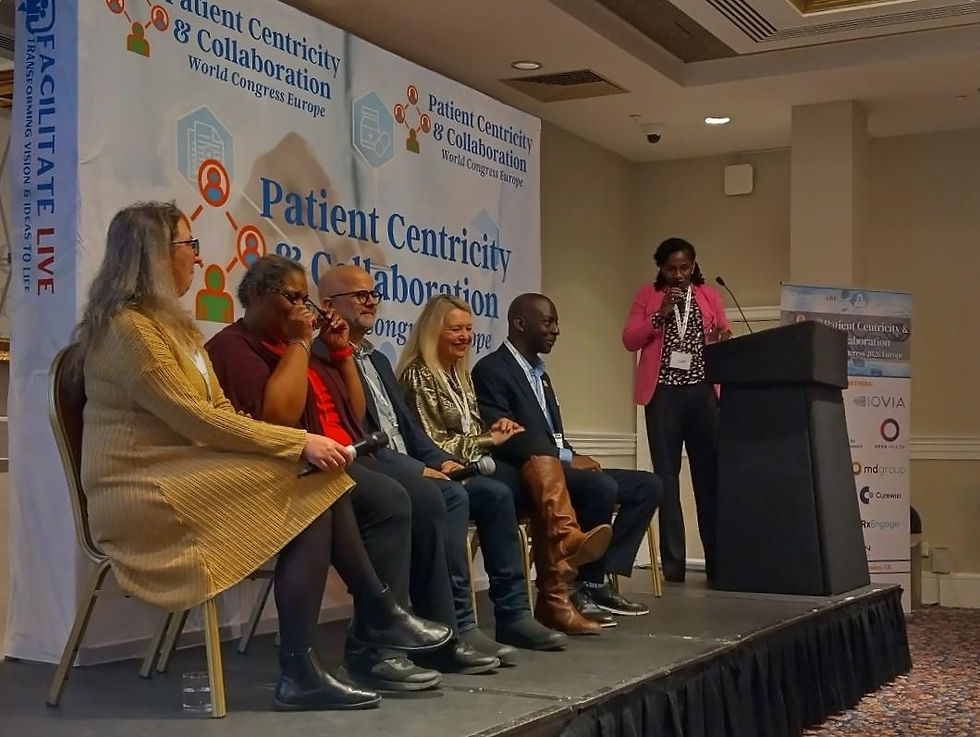
The day began with discussions surrounding DEI. ISPEP PEP Talks guest Ify Osunkwo set the tone by stating, “We don't want to rehash the problems. We want to move towards solutions”.
Faith Smith from the Health Innovation Network emphasised that building trust starts with the fundamentals of explaining what research actually is, noting that many people still view it with suspicion or fear of the unknown ( "[People might think you’re just] given a tablet, your skin goes green, and you don't know why"). She also highlighted practical barriers that are often overlooked, such as trial appointments clashing with school holidays and childcare responsibilities. Emily Pickering (NIHR) shared how the NIHR is now requiring all applications to demonstrate how they have considered sex and gender.
In the following session, Puja Myles from the MHRA discussed the importance of considering diversity beyond just race and ethnicity. The MHRA's vision for diversity and inclusion plans encompasses demographic, clinical, treatment environment, and socio-economic factors. While the MHRA has published guidance for sponsors to submit these plans as part of their research application, they are currently part of a pilot program and are not yet mandatory.
Involving patients in early discovery
Liz Clark provided a compelling case for involving patients much earlier in the development lifecycle, specifically during target identification, lead generation, lead optimisation, and candidate selection. She noted that while preclinical research can feel abstract, patient involvement "humanises lab research," connecting test tubes to real-world stories and improving study relevance, quality and efficiency.
Liz argued that patients don't need to understand the complexities of lab processes to provide value; rather, they can provide critical insights on preferences and trade-offs regarding administration burden versus efficacy. This involvement also helps build trust early on, as patient partners feel more confident in treatments they have seen being developed from the ground up.
Information and support needs
A standout panel hosted by Keith Berelowitz followed, featuring only people with lived experience. This panel highlighted a staggering disconnect: while billions are spent globally on marketing clinical trials, many people still have no idea that relevant trials even exist. ISPEP Advisor Danielle Drachmann called for the integration of research education into school curricula (in addition to sharing trial opportunities through everyday care) to bridge this gap.

The panel also brought the emotional weight of patient journeys to the forefront. Jamie, a father of a son (also named Jamie) with Duchenne muscular dystrophy, shared a powerful story of a trial in the US falling through at the last moment after his family had already sold their home so they could relocate from the UK. “I wish the research community understood how emotional it is to search for options,” he remarked, “because you're not just looking for a trial, you're truly searching for hope”.
A later session from Sumira Riaz (Unboxed Psychology) and Glenn Darley (Rare Connections Consulting) highlighted that psychological and emotional challenges are essential to consider alongside clinical endpoints. These include the "fear of placebo," the mental drain of choosing between financial security and a "last chance" at survival (trial participation can jeopardise job security / earning opportunities), and the general fatigue of processing a constant barrage of medical information. During the Q&A, Emma Sutcliffe noted a fear among study participants when an investigational treatment then fails to receive a license, leaving them uncertain about the long-term impact of the trial on their health.
The power of persistence
Zack Pemberton-Whiteley shared a "success story that followed 10 years of failure" regarding a Novartis trial for chronic myeloid leukemia (CML). This success was the result of a decade of general collaboration between Novartis and a standing advisory board of patient advocates who worked routinely to design Phase II and Phase III trials.
As part of this ongoing collaboration, the patient advisory board called for the removal of an unnecessary, painful bone marrow biopsy that was ‘required’ just two weeks after an initial diagnostic biopsy. When the procedure was finally removed for the Phase III trial, recruitment finished 12 months ahead of schedule. This change likely contributed to a market share advantage worth over $1.1 billion, demonstrating that reducing patient burden is a major business win achieved through persistent, long-term partnership.
Navigating regulatory and psychological barriers
During a panel hosted by Gabor Purman (Kyowa Kirin), Emma Sutcliffe shared how replacing daily needles with self-injection pens for children with Growth Hormone Deficiency transformed "terror before bedtime" into a normal routine, a change driven entirely by listening to patient and caregiver feedback.
The conversation also touched on a challenging EMA conflict of interest policy, which can ban patient experts from regulatory discussions for three years if they have received even minor travel reimbursements from industry. Some companies are now attempting to create "firewalls" by ensuring that the patient advocates who work with them are different from those who represent the community to regulators, although advocacy efforts are ongoing via Rare Disease Research Partners to adapt these regulations for rare disease communities where the pool of available advocates may be very small.
Summary
Key takeaways:
Meaningful commitment to DEI requires structural change.
Preclinical patient engagement humanises science and benefits both patients and lab teams.
Emotional and psychological impact must be accounted for in healthcare and research.
Patient input brings business wins and protects against unnecessary, invasive procedures.
Qualitative data is often the missing link between traditional endpoint data and patient realities.
EMA COI policies can pose a barrier to patient involvement in regulatory processes if not managed carefully.
Calls to action:
Integrate research opportunities into everyday care for people with rare diseases and provide clearer, simpler information about clinical trial options upon diagnosis so families are not ‘sent home with no hope’.
Follow the lead of companies like Roche and Pfizer by employing or contracting a Patient Experience Officer with lived experience.
Publish reports on the process and experience of patient involvement in preclinical Include open-ended patient-reported questions in trial protocols to capture side effects, reasons for early termination, and the reality of administration burdens. Work to ensure regulators recognise and value qualitative evidence alongside quantitative data.
Actively seek input from patients who are not enthusiastic about trials to gain valuable insights into barriers to participation.
Strategically manage patient expert involvement to ensure community voices are not silenced by EMA conflict-of-interest policies.


Comments